Getting someone’s attention is only the beginning of marketing.
A person might see your Instagram post, Google ad, website or blog article, but that does not automatically mean they will become a customer.
Effective marketing moves people through a journey. They first become aware of your business, develop an interest in what you offer, decide that your solution is right for them and finally take action.
This is where the AIDA marketing model comes in.
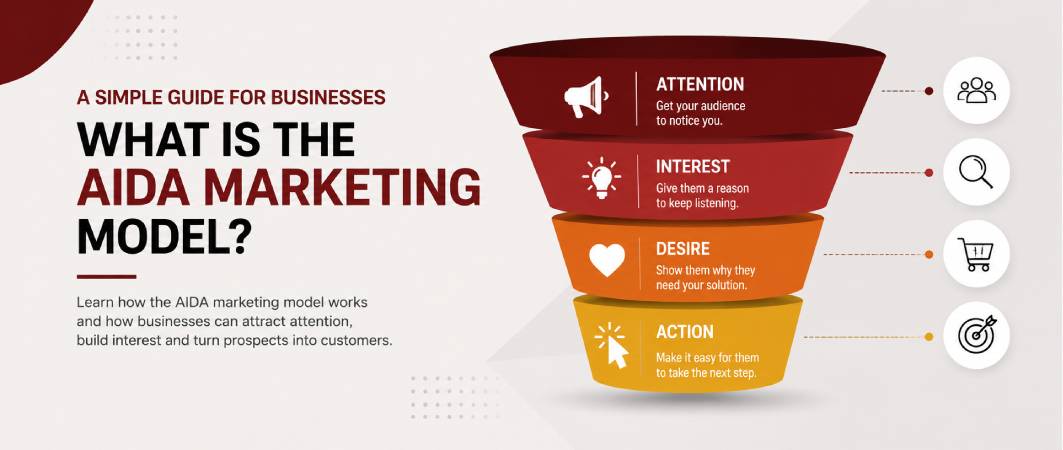
AIDA stands for Attention, Interest, Desire and Action. It is a simple framework that helps businesses understand how potential customers move from discovering a brand to making a decision.
Here’s how it works.
What Does AIDA Stand For?
The AIDA marketing model has four stages:
A — Attention
Get your audience to notice you.
I — Interest
Give them a reason to keep paying attention.
D — Desire
Show them why they need your product or service.
A — Action
Make it easy for them to take the next step.
The four stages work together to create a marketing journey rather than treating every post or advert as an isolated message.
1. Attention: Get People to Notice Your Business
The first challenge is getting noticed.
Your potential customers are exposed to thousands of marketing messages every day. If your content looks and sounds like everything else, people will scroll past it.
Attention can come from:
- A strong headline
- An eye-catching visual
- A compelling video
- A surprising statistic
- A question that addresses a customer problem
- A Google search result
- A targeted advertisement
For example, instead of a generic headline such as:
“We Offer Digital Marketing Services”
you could say:
“Is Your Business Invisible on Google?”
The second message immediately speaks to a problem that a potential customer may already have.
That’s attention.
2. Interest: Give Them a Reason to Keep Reading
Getting someone’s attention is not enough.
Once you have their attention, your marketing needs to create interest. This is where you start explaining the problem and showing that you understand your audience.
For example, if your headline is:
“Is Your Business Invisible on Google?”
the next part could explain:
Your customers are searching for the products and services you offer, but if your website isn’t appearing in search results, they’re finding your competitors instead.
Now the reader has a reason to continue.
Good marketing creates interest by answering questions, educating the audience and showing that you understand their challenges.
This is why useful blog articles, educational social media posts and informative videos are important.
3. Desire: Show Them Why They Need Your Solution
Interest means someone is paying attention.
Desire means they start thinking:
“I need this.”
At this stage, your marketing should connect your solution to the customer’s specific problem.
Instead of simply listing what your business does, focus on the outcome.
For example:
Feature:
“SEO optimisation for your website.”
Benefit:
“Improve your visibility when potential customers search Google for the services you offer.”
The difference is important.
People don’t usually buy a product or service because of the feature itself. They buy because of what that feature can help them achieve.
Testimonials, case studies, demonstrations, before-and-after examples and clear benefits can all help create desire.
4. Action: Tell Them What to Do Next
You’ve captured attention.
You’ve created interest.
You’ve built desire.
Now you need to make taking action simple.
This is where your call to action (CTA) comes in.
Examples include:
- Get a Free Consultation
- Request a Quote
- Book a Strategy Session
- Shop Now
- Contact Us
- Chat on WhatsApp
- Download the Guide
- Subscribe
Don’t make your audience guess what to do next.
If someone is ready to contact your business but cannot find your phone number, contact form or WhatsApp button, you could lose the lead.
A strong marketing message should make the next step obvious.
How AIDA Works in Social Media
AIDA can be applied to a single social media campaign or across your entire content strategy.
For example, imagine you’re a website design company.
Attention
“Your website might be costing you customers.”
Interest
“If your website is slow, difficult to use or impossible to find on Google, potential customers may leave before contacting you.”
Desire
“A fast, mobile-friendly website can help you build trust, improve user experience and turn more visitors into enquiries.”
Action
“Book a free website consultation.”
The same principle can be used for Instagram, Facebook, TikTok, LinkedIn, Google Ads, landing pages and email marketing.
How AIDA Works on a Website
AIDA isn’t only for advertisements and social media.
Your website can also guide visitors through the same journey.
Attention
Your headline immediately communicates what you offer.
Interest
Your supporting content explains the problem you solve.
Desire
Your services, benefits, portfolio, testimonials and case studies demonstrate your value.
Action
Your contact form, WhatsApp button or consultation CTA gives visitors a clear next step.
This is one reason a good website needs more than attractive design. It needs to guide visitors toward action.
Why Businesses Should Use the AIDA Model
AIDA helps you stop creating marketing content simply because you feel like you need to post something.
Instead, you start asking:
What do I want this content to achieve?
Some content might be designed to generate attention.
Other content might educate your audience.
Another piece might demonstrate your expertise or show a customer result.
And some content should directly encourage people to contact or buy from you.
Together, these pieces create a more effective marketing strategy.
AIDA Isn’t a Strict Formula
It’s important to remember that customers don’t always move through AIDA in a perfectly straight line.
Someone might discover your business through Google, visit your website, follow you on Instagram, see your content several times and only contact you weeks later.
Another customer might see a Google ad and contact you immediately.
AIDA is therefore best used as a framework for understanding and improving your marketing, rather than a rigid formula that every customer must follow.
How Osyne Uses AIDA
At Osyne, we apply the principles behind AIDA across the digital marketing work we do for businesses.
From website design and SEO to social media management, paid advertising, graphic design and content creation, every part of your online presence should have a purpose.
Your marketing shouldn’t just get attention.
It should help move the right people from “I’ve seen this business” to “This is exactly what I need.”
Ready to Build Marketing That Converts?
If your business is getting attention online but not enough enquiries or sales, the problem may not be how much you’re marketing. It may be how you’re moving people from awareness to action.
Osyne helps businesses build strategic digital marketing campaigns designed to attract the right audience, build trust and generate measurable business results.
Ready to improve your marketing strategy? Get in touch with Osyne today.