Getting someone to discover your business online is only the first step.
A person might find your website through Google, see one of your social media posts, click a Google ad or hear about your business from someone else. But discovering your business doesn’t automatically mean they will become a customer.
There is usually a journey between first discovering your business and making a purchase or contacting you.
That journey is called a conversion funnel.
Understanding your conversion funnel can help you identify where potential customers are dropping off, improve your marketing and create a clearer path from awareness to action.
In this guide, we’ll explain what a conversion funnel is, how it works, the different stages, examples, common mistakes and how businesses can improve their funnels.
What Is a Conversion Funnel?
A conversion funnel is the journey a potential customer takes from first becoming aware of a business to completing a desired action.
That action could be:
- Making a purchase
- Requesting a quote
- Booking a consultation
- Filling out a form
- Calling a business
- Signing up for a service
- Downloading a resource
- Starting a free trial
It is called a “funnel” because businesses often have many people entering at the beginning, while fewer people progress to the final conversion.
For example:
1,000 people see your content
↓
300 visit your website
↓
80 view your service page
↓
25 submit an enquiry
↓
8 become customers
Not everyone who discovers your business will buy from you.
The goal of a conversion funnel is to understand that journey and make each stage work better.
Why Does a Conversion Funnel Matter?
Without a clear funnel, businesses can end up focusing heavily on getting traffic without understanding what happens afterward.
You might have:
- Website visitors but few enquiries
- Social media followers but few customers
- Google Ads clicks but few conversions
- Lots of enquiries but few sales
- Many people visiting a landing page but not completing the form
A funnel helps you look beyond traffic and ask:
What happens after someone discovers my business?
This is particularly important because successful digital marketing isn’t simply about attracting attention.
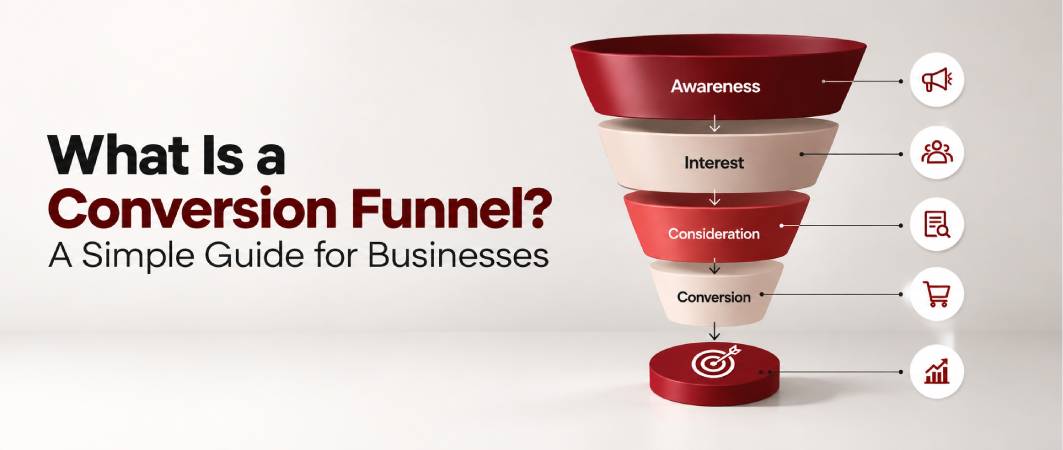
It is about moving the right people from awareness → interest → consideration → action.
The Main Stages of a Conversion Funnel
There are different ways to structure a conversion funnel, but a simple model for most businesses is:
1. Awareness
At the awareness stage, someone discovers your business for the first time.
They may find you through:
- Google Search
- Google Maps
- Social media
- YouTube
- Blog content
- Paid advertising
- Referrals
- Online publications
- Word of mouth
At this point, the person may not be ready to buy.
They are simply becoming aware that your business exists.
2. Interest
Once someone knows about your business, they may become interested in what you offer.
They might:
- Visit your website
- Follow your social media account
- Read a blog article
- Watch a video
- Explore your services
- Download a guide
- Subscribe to your email list
Your job at this stage is to give them useful information and a reason to continue.
3. Consideration
Now the potential customer is actively evaluating whether your business is right for them.
They may compare:
- Services
- Pricing
- Reviews
- Experience
- Features
- Results
- Portfolio
- Guarantees
- Customer support
This is where trust becomes particularly important.
Your website should make it easy for potential customers to understand what you offer, who you serve and why they should consider you.
4. Conversion
The person takes the action you want them to take.
Depending on your business, this could be:
- Buying a product
- Booking a consultation
- Requesting a quote
- Completing a contact form
- Calling your business
- Starting a trial
- Making a booking
This is the point where a visitor becomes a lead or customer.
However, conversion doesn’t always mean an immediate purchase.
For a service business, a completed enquiry form may be the conversion, while the actual sale happens later.
5. Retention
The funnel doesn’t necessarily end when someone becomes a customer.
After the first purchase, businesses can focus on:
- Customer satisfaction
- Repeat purchases
- Upselling
- Cross-selling
- Referrals
- Reviews
- Loyalty
A satisfied customer can also become an important source of future business.
Conversion Funnel Example
Imagine a company that provides website design services.
Someone searches Google for:
“professional website design company”
They discover the company’s website.
Awareness
They find the business through Google.
Interest
They read a blog article about business website design.
Consideration
They visit the services page and portfolio.
They then look at testimonials and previous projects.
Conversion
They click:
“Get a Free Consultation”
and submit the enquiry form.
Sales
The business follows up, discusses the customer’s requirements and provides a proposal.
Retention
After completing the website, the business offers ongoing SEO or website maintenance.
That’s a conversion funnel in action.
What Is a Conversion?
A conversion is simply a desired action completed by a visitor or potential customer.
The definition depends on your business.
For an ecommerce store:
Conversion = purchase
For a marketing agency:
Conversion = qualified enquiry
For a SaaS company:
Conversion = free trial or demo
For a restaurant:
Conversion = reservation
For a newsletter:
Conversion = subscription
This is why businesses should define their conversions before measuring marketing performance.
What Is a Conversion Rate?
Your conversion rate measures the percentage of visitors who complete a desired action.
For example, if 1,000 people visit your website and 30 submit your enquiry form, your conversion rate is 3%.
Understanding conversion rates helps you determine whether your marketing is simply generating traffic or actually producing meaningful actions.
What Is a Marketing Funnel vs a Sales Funnel?
These terms are sometimes used interchangeably, but they can refer to different parts of the customer journey.
Marketing Funnel
The marketing funnel generally focuses on attracting and nurturing potential customers.
For example:
Content → Website → Email → Lead
Sales Funnel
The sales funnel focuses more closely on turning a qualified lead into a customer.
For example:
Lead → Consultation → Proposal → Negotiation → Customer
For many businesses, the two work together.
Marketing generates and nurtures opportunities, while sales helps turn qualified opportunities into customers.
How Digital Marketing Fits Into a Conversion Funnel
Different marketing channels can support different stages of your funnel.
SEO
SEO can help people discover your business when they search for relevant information, products or services.
Google Ads
Paid search can put your business in front of people actively searching for specific products or services.
Social Media
Social media can build awareness, demonstrate expertise and nurture relationships.
Content Marketing
Blog posts, guides, videos and other content can answer questions and help potential customers evaluate your business.
Website
Your website brings these channels together and provides information, proof and opportunities to convert.
Email Marketing
Email can help nurture prospects who aren’t ready to buy immediately.
The important thing is that these channels shouldn’t operate completely independently.
They should move people toward a meaningful action.
How to Build a Conversion Funnel for Your Business
Step 1: Define Your Goal
Start with the end.
Ask:
What do I want visitors to do?
For example:
- Buy
- Book
- Call
- Request a quote
- Complete a form
- Schedule a consultation
Step 2: Define Your Target Customer
Understand who you’re trying to attract.
Consider:
- Their needs
- Problems
- Goals
- Buying behaviour
- Location
- Budget
- Search behaviour
The clearer your audience, the easier it becomes to create relevant marketing.
Step 3: Choose Your Acquisition Channels
Decide how people will discover your business.
You might use:
- SEO
- Google Ads
- Social media
- Content marketing
- Referrals
- Partnerships
You don’t necessarily need every channel.
Choose the channels that align with how your customers actually search and make decisions.
Step 4: Create Content for Each Stage
Someone discovering your business for the first time needs different information from someone who is ready to buy.
For example:
Awareness:
“What Is SEO?”
Consideration:
“How Much Does SEO Cost?”
Conversion:
“Book a Free SEO Consultation”
Each piece of content should have a purpose.
Step 5: Create a Clear Conversion Path
Don’t make visitors figure out what to do next.
Use clear calls to action such as:
- Get a Quote
- Book a Consultation
- Request a Demo
- Start Free Trial
- Contact Us
- Shop Now
The CTA should match the visitor’s stage and intent.
Step 6: Measure the Funnel
Track what happens at each stage.
For example:
Traffic → Engagement → Leads → Qualified Leads → Sales
This helps you identify where improvements are needed.
How to Improve a Conversion Funnel
If people are entering your funnel but not converting, don’t immediately assume you need more traffic.
The problem could be further down the funnel.
Improve Your Landing Pages
Make sure the page clearly communicates:
- What you’re offering
- Who it’s for
- The benefits
- Why customers should trust you
- What they should do next
Strengthen Your Calls to Action
A vague CTA like:
Submit
is usually less informative than:
Get My Free Consultation
Your CTA should tell visitors what happens when they click.
Add Social Proof
Trust can influence purchasing decisions.
Consider using:
- Customer reviews
- Testimonials
- Case studies
- Client logos
- Portfolio examples
- Certifications
- Industry experience
Only use genuine claims and customer evidence.
Reduce Friction
Every unnecessary step can create another opportunity for someone to abandon the process.
For example, a lead form may not need fifteen fields.
Ask only for information you actually need at that stage.
Improve Website Speed and Mobile Experience
If your website is slow, difficult to navigate or difficult to use on mobile devices, visitors may leave before reaching your conversion point.
Match Your Message to Search Intent
Someone searching:
“what is SEO?”
is likely at a different stage from someone searching:
“SEO agency pricing.”
Your content and CTA should reflect that difference.
Common Conversion Funnel Mistakes
Focusing Only on Traffic
More traffic doesn’t automatically mean more customers.
Sending Every Visitor to the Homepage
Different campaigns and search queries often deserve relevant landing pages.
Having Too Many Calls to Action
If every page asks visitors to do five different things, the primary action can become unclear.
Making the Customer Do Too Much Work
Complex forms, unclear navigation and unnecessary steps can create friction.
Ignoring Follow-Up
A lead that submits an enquiry but never receives a response quickly may move on to another business.
Not Tracking Conversions
Without conversion tracking, it becomes difficult to know which marketing activities are generating results.
How to Know Where Your Funnel Is Breaking
Look at each stage separately.
Lots of Impressions but Few Clicks
Potential issue:
Your message, targeting or creative may not be attracting enough attention.
Lots of Clicks but Few Website Engagements
Potential issue:
The landing page may not match what the visitor expected.
Lots of Visitors but Few Leads
Potential issue:
Your offer, CTA, trust signals or conversion experience may need improvement.
Lots of Leads but Few Sales
Potential issue:
The problem may be qualification, follow-up, pricing, sales process or the quality of leads being generated.
This is why funnel analysis is useful.
Instead of simply saying:
“Our marketing isn’t working.”
you can ask:
“Which stage is losing the most potential customers?”
Conversion Funnel Metrics to Track
Depending on your business, useful metrics can include:
- Website traffic
- Click-through rate
- Engagement rate
- Landing page conversion rate
- Lead volume
- Cost per lead
- Qualified leads
- Sales conversion rate
- Customer acquisition cost
- Average order value
- Repeat purchase rate
- Return on marketing investment
You don’t need to track every possible metric.
Focus on the measurements that help you understand whether your marketing is contributing to business objectives.
Conversion Funnel vs Customer Journey
A conversion funnel and customer journey are related but aren’t exactly the same.
A conversion funnel provides a structured model for understanding movement toward a desired action.
A customer journey looks more broadly at the customer’s experience across interactions with your business.
For example, a customer might:
See your social media post → visit your website → leave → see your Google ad → read your blog → return through Google → contact you → speak with your sales team → become a customer.
Real customer journeys aren’t always perfectly linear.
That’s why businesses should use the funnel as a framework rather than assuming every customer follows exactly the same sequence.
A conversion funnel gives your business a way to understand what happens between someone discovering you and becoming a customer.
Instead of looking at marketing as simply generating traffic, you can examine the complete journey:
Awareness → Interest → Consideration → Conversion → Retention
The biggest opportunity isn’t always at the top of the funnel.
Sometimes the business already has enough traffic but needs a better landing page. Sometimes it needs stronger trust signals. Sometimes leads aren’t being followed up effectively.
The key is to understand where potential customers are dropping off and improve that specific stage.
Need Help Building a Digital Marketing Funnel?
At Osyne, we help businesses combine websites, SEO, social media, paid advertising and content into digital strategies designed to attract the right audience and turn online attention into enquiries.
Whether you’re targeting customers locally or building an international presence, your marketing should have a clear path from visibility to conversion.
Ready to build a stronger digital marketing strategy?