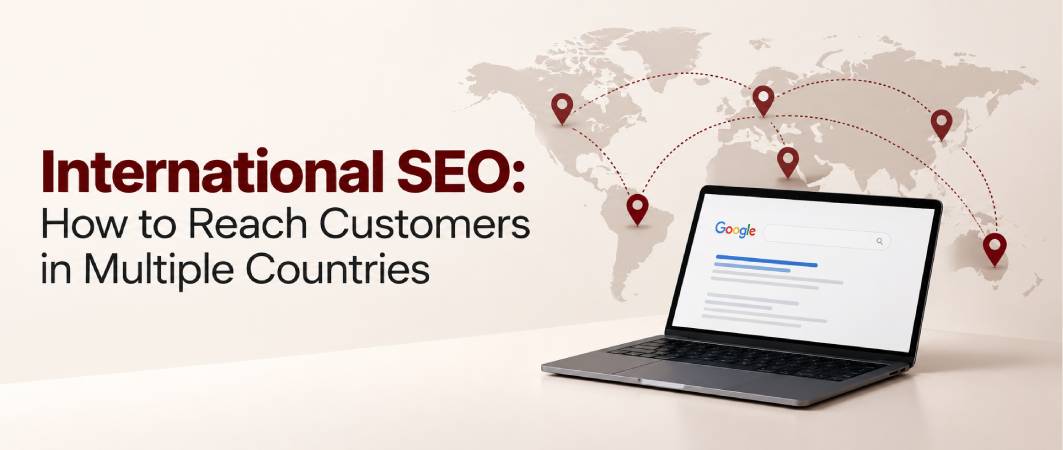
Your business may offer excellent products or services, but if your website only reaches people in one market, you could be missing opportunities to grow.
Today, businesses can reach potential customers across borders through search engines. However, attracting international customers requires more than publishing content and hoping people in other countries find it.
You need a strategy that helps search engines understand which audiences you serve, while giving potential customers relevant information for their market.
This is where international SEO becomes important.
Whether you’re a small business looking to expand abroad, a service provider targeting clients in multiple countries, or an established company entering new markets, international SEO can help you build visibility beyond your home market.
In this guide, you’ll learn what international SEO is, how it works, how to structure your website for different markets and how to build a strategy that supports sustainable international growth.
What Is International SEO?
International SEO is the process of optimizing your website so search engines can understand which countries or language audiences your content is intended for.
The goal is to make your website more relevant and accessible to potential customers in the markets you want to reach.
For example, a digital marketing agency based in Kenya might want to attract clients in the United Kingdom, United States, Canada and Australia.
Its international SEO strategy could include:
Researching search behaviour in each target market
Creating service pages that address different customer needs
Using relevant keywords for each market
Structuring the website for international audiences
Improving website speed and usability
Earning relevant links and industry mentions
Creating content that answers local customer questions
International SEO isn’t limited to large multinational companies. Smaller businesses can also use it to reach customers in new markets when their products or services are suitable for those audiences.
Google distinguishes between multilingual websites, which offer content in different languages, and multiregional websites, which target users in different countries.
Why Is International SEO Important?
Expanding into another market creates new opportunities, but it also introduces new competition.
Your website needs to demonstrate that your business understands the needs of the people you’re trying to reach.
Here are some of the main benefits of international SEO.
1. Reach Customers Beyond Your Home Market
Your website doesn’t have to attract visitors exclusively from the country where your business operates.
If your services can be delivered remotely or your products can be shipped internationally, organic search can help you connect with relevant audiences in other countries.
For example, a web design agency can work with businesses in different regions without needing a physical office in every market.
2. Attract More Relevant Website Traffic
International SEO isn’t simply about increasing the number of visitors.
It’s about attracting people who are searching for services, products or information relevant to your business.
A smaller number of qualified visitors from your target markets may be more valuable than a large volume of unrelated traffic.
3. Build Brand Awareness Internationally
When your website consistently appears for relevant searches, potential customers have more opportunities to discover your business.
Useful content, clear service pages and credible industry references can help establish your brand in markets where people may not know you yet.
4. Generate International Leads
For service-based businesses, international SEO can help attract visitors who are actively looking for solutions.
These visitors can then move from an informative article to a service page, portfolio or enquiry form.
The objective is to turn relevant search visibility into genuine business opportunities.
5. Build a Sustainable Acquisition Channel
Paid advertising can generate visibility while campaigns are running. SEO, by contrast, can continue attracting organic traffic after pages gain visibility, although results are not guaranteed and ongoing optimization is often necessary.
A well-developed international SEO strategy can become one part of a broader, diversified customer acquisition system.
How Does International SEO Work?
International SEO combines standard SEO practices with decisions about geography, language and customer needs.
A successful strategy typically involves five key areas:
Market and keyword research
Localized content
Website structure
Technical SEO
Authority and trust
Let’s explore each one.
Step 1: Choose the Right International Markets
Before optimizing your website for several countries, decide which markets are worth targeting.
Trying to target every country at once can spread your resources too thinly.
Instead, begin with a manageable number of markets and evaluate their potential.
Research demand for your services
Look at whether people in your target countries are searching for the services or products you offer.
You can use tools such as Google Keyword Planner, Google Trends and Google Search Console to investigate search demand, keyword variations and existing website performance.
Consider questions such as:
Are people searching for your services in that market?
How competitive are the relevant search results?
Can your business serve customers in that country?
Does your pricing suit the market?
Can you provide support, delivery or fulfilment?
Are there legal or operational requirements to consider?
Evaluate commercial potential
Search demand alone doesn’t guarantee that a market will generate profitable business.
Consider the likely value of a customer, the cost of delivering your service, competition and the resources needed to establish a presence.
For example, an agency targeting international clients might initially prioritize two markets where it can demonstrate relevant expertise instead of attempting to target ten countries simultaneously.
The goal is to prioritize markets where search demand, customer needs and your business capabilities align.
Step 2: Conduct Keyword Research for Each Market
One of the most important parts of international SEO is understanding how people search in different countries.
The same service can be described differently across markets.
For example, people may use different terminology for professional services, products, prices or specific features.
Even when two countries share the same language, their search behaviour may differ.
Don’t assume one keyword works everywhere
Suppose your business provides website design.
You might find that people in different markets use variations such as:
Website design services
Web design agency
Business website design
Professional web development services
These phrases overlap, but their search intent and commercial value can vary.
Research actual search results and keyword data before deciding which phrases to target.
Identify search intent
Search intent refers to what someone wants to accomplish when they enter a query.
A person searching for “what is website design” may be looking for information.
Someone searching for “hire a web design agency” is more likely to be evaluating providers.
Your content should reflect the intent behind each search.
For example:
Search intent | Content to create |
|---|---|
Informational | Guides, tutorials and educational articles |
Commercial investigation | Service comparisons, case studies and portfolio pages |
Transactional | Service pages, pricing pages and enquiry pages |
Navigational | Brand and business-specific pages |
This approach helps you build content that supports customers at different stages of their decision-making process.
Step 3: Create Content for Your Target Markets
International SEO requires more than publishing the same generic content for everyone.
Your website should address the needs, expectations and questions of your intended audience.
Create relevant service pages
If your business provides services internationally, explain clearly what you offer and which customers you serve.
For example, a marketing agency might have service pages explaining how it supports:
Startups seeking digital visibility
Small businesses generating online leads
Established companies expanding into new markets
Businesses seeking ongoing SEO or paid advertising
If different markets have genuinely different requirements, create useful localized pages that address those differences.
Avoid creating near-identical pages for every country
Creating dozens of pages that only change the country name can result in thin, repetitive content that offers little value to visitors.
Instead, create a country-specific page when there is a genuine reason to do so.
That might include differences in:
Services available
Customer expectations
Regulations
Pricing or payment arrangements
Case studies and customer evidence
Industry terminology
Local competition
Each page should offer meaningful information for its intended audience.
Publish content that answers international customers’ questions
Your blog can support international SEO by addressing questions potential customers are searching for.
Useful topics might include:
How to choose a digital marketing agency
How to evaluate website design services
How to measure marketing performance
How to generate leads through organic search
How to prepare a business website for international growth
The most effective topics depend on your target market and the services you want to sell.
Step 4: Choose the Right Website Structure
Your website structure helps organize content for different markets and languages.
Google documents several options for international websites, each with advantages and disadvantages.
The three common options are country-specific domains, subdomains and subdirectories.
Option 1: Country-specific domains
Example: example.co.uk or example.de
These domains provide a clear country association. However, managing several separate domains can increase costs and operational complexity.
Option 2: Subdomains
Example: uk.example.com
Subdomains can separate regional sections, but may require additional configuration and management.
Option 3: Subdirectories
Example: example.com/uk/
Subdirectories keep regional content on the same domain and are often simpler to manage for businesses building their international presence.
Which structure should you choose?
For many smaller businesses expanding internationally, subdirectories are a practical starting point because they allow the business to maintain one domain.
However, the right structure depends on your business model, technical resources, language requirements and whether the content genuinely needs to differ by country.
You do not necessarily need a separate website for every country you serve.
Step 5: Implement Hreflang Correctly
If your website offers different language or regional versions of the same page, you should help Google understand the relationship between those versions.
This is where hreflang annotations can help.
For example, a business might provide separate English-language pages for the United States and the United Kingdom.
An illustrative implementation could look like this:
<link rel="alternate" hreflang="en-us"
      href="https://example.com/us/" />

<link rel="alternate" hreflang="en-gb"
      href="https://example.com/uk/" />

<link rel="alternate" hreflang="x-default"
      href="https://example.com/" />
These annotations tell search engines which regional or language variants are associated with each other.
Google recommends that each version reference itself and the other relevant versions, with consistent, valid URLs.
Important: You do not need hreflang simply because you want customers from several countries to visit one English-language website.
It is most useful when you have distinct language or regional versions that search engines should associate with one another.
Incorrect implementation can create confusion, so validate it before deployment.
Step 6: Optimize Your Website for Technical SEO
Your international pages still need a technically sound website.
Important checks include:
Ensure important pages can be crawled and indexed.
Use descriptive, consistent URLs.
Maintain a logical internal linking structure.
Optimize page loading performance.
Ensure the website works well on mobile devices.
Use appropriate canonical tags.
Submit a valid XML sitemap.
Avoid automatically redirecting visitors based solely on their IP address or browser language.
Google cautions that automatic redirects based on perceived location or language can prevent users and search engines from accessing all relevant versions of a website. Providing clear links for users to choose their preferred region or language is a better approach.
Make your international pages accessible
Every important regional page should have a clear, crawlable URL.
Don’t rely exclusively on a visitor selecting a country through a script that search engines may not be able to follow.
Your international pages should be accessible through normal links and included in your site’s navigation or relevant internal links.
Step 7: Build Authority in Your Target Markets
Strong international SEO involves more than on-page optimization.
Your business also needs credibility.
Relevant links, mentions and references from trusted websites can help search engines and potential customers discover your brand.
Ways to build international authority
Consider:
Contributing useful expert articles to relevant publications
Building relationships with industry partners
Participating in relevant business communities
Publishing original research or useful resources
Showcasing genuine customer projects
Earning mentions from relevant industry websites
Creating content that others naturally want to reference
Focus on earning relevant, legitimate references rather than purchasing large volumes of low-quality links.
You should also demonstrate your credibility directly on your website through clear service descriptions, genuine testimonials, relevant case studies and transparent business information.
Step 8: Localize the Customer Experience
International SEO doesn’t end when someone lands on your website.
Visitors need to understand whether your business can serve them and how to take the next step.
Consider the following elements.
Currency and pricing
If you publish prices, make the applicable currency and pricing conditions clear.
Don’t imply that you provide local pricing or fulfilment in a country unless you actually do.
Language and terminology
Use language that feels natural to the audience.
For example, English-language content for a US audience may use different terminology from content intended for a UK audience.
Contact information
Make it clear how international customers can contact your business.
Explain your operating hours, communication channels and service availability where relevant.
Trust signals
Customers in unfamiliar markets may need additional reassurance before working with your business.
Useful trust signals include:
A clear About page
Relevant case studies
Genuine testimonials
A professional portfolio
Transparent service terms
Secure website functionality
Clear contact information
Calls to action
Your calls to action should fit the customer journey.
Examples include:
Request a Quote
Book a Consultation
View Our Work
Discuss Your Project
Get a Free Strategy Session
The goal is to make it easy for a potential customer to take the next step.
Step 9: Track International SEO Performance
You cannot reliably improve your strategy if you don’t understand how your website performs in each market.
Use Google Search Console to examine search performance by country, query, page and other available dimensions.
Use web analytics to understand what visitors do after arriving on your website.
Track metrics such as:
Metric | What it tells you |
|---|---|
Organic clicks | How many visits search results generate |
Impressions | How often your pages appear in search results |
Click-through rate | How often impressions lead to clicks |
Country-level traffic | Which markets generate visitors |
Engagement | How visitors interact with your website |
Enquiries by market | Which countries generate leads |
Qualified leads | Whether those enquiries match your target customers |
Sales and revenue | Whether your marketing contributes to business results |
Don’t judge international SEO solely by the number of visitors.
A market generating fewer visitors but more qualified enquiries may be more valuable than a market producing large volumes of irrelevant traffic.
Common International SEO Mistakes to Avoid
1. Targeting Too Many Countries at Once
Start with the markets that offer the strongest business potential and expand as you gain evidence.
2. Translating Content Without Localizing It
Direct translation may not reflect the language, search behaviour or needs of the intended audience.
3. Duplicating Pages Without Adding Value
Country pages should serve a real audience need rather than exist only to target location keywords.
4. Choosing a Complicated Website Structure Too Early
Multiple domains and regional websites can create additional maintenance and technical work. Choose a structure you can manage effectively.
5. Ignoring Technical SEO
Incorrect canonical tags, inaccessible pages or broken regional links can undermine your strategy.
6. Assuming English Means One Global Audience
Different English-speaking markets can have different terminology, expectations and search behaviour.
7. Measuring Traffic Instead of Business Results
Track enquiries, qualified leads and revenue alongside visibility.
8. Expecting Immediate Results
SEO takes time, and competition varies between markets. Monitor progress and refine the strategy based on evidence rather than expecting every international page to rank quickly.
How Long Does International SEO Take?
There is no fixed timeline for international SEO.
The time required depends on factors such as:
Your website’s existing authority
Competition in your target markets
The quality of your content
Technical implementation
Search demand
Your resources and consistency
If your website already has a solid SEO foundation, expanding into a new market may be easier than building visibility from scratch.
However, new regional pages still need to be discovered, indexed and assessed by search engines.
A practical approach is to establish baseline metrics, prioritize a small number of markets and review performance regularly.
A Practical International SEO Strategy for Small Businesses
You don’t need to build a complex global website on day one.
Start with a manageable plan.
Choose one or two priority markets. Base your decision on customer demand, business fit and commercial potential.
Research keywords for each market. Identify how potential customers search for your services and what they expect to find.
Optimize your core service pages. Clearly explain your offering, target audience, value and next steps.
Create helpful supporting content. Publish articles that address the questions customers ask before choosing a provider.
Check technical foundations. Review indexing, internal links, site speed, canonical tags and regional markup where applicable.
Build credibility. Use genuine case studies, testimonials, industry relationships and relevant links.
Measure results. Compare visibility, enquiries and lead quality across your target markets.
Expand based on evidence. Invest in additional markets once you understand what is working.
This approach allows your business to learn and improve without spreading its resources too thinly.
Frequently Asked Questions
International SEO is the process of optimizing a website to reach relevant audiences across different countries or languages through search engines.
No. Small businesses, freelancers, agencies and online service providers can use international SEO if they can serve customers in other markets.
No. You can use one domain with country or language subdirectories, subdomains or other appropriate structures. The right choice depends on your needs and resources.
International SEO focuses on reaching audiences across countries or language markets. Local SEO focuses on visibility for geographically relevant searches, particularly for businesses serving customers in specific locations.
hreflang is an annotation that helps Google understand the relationship between alternate language or regional versions of a page and select an appropriate version for searchers.
Yes. If you serve customers in multiple English-speaking countries and your content is relevant to them, a single English-language website may be sufficient. Create distinct regional pages when there is a genuine need for different content or offerings.
No. If your target audiences use the same language as your existing website, you may not need translations. You may still need to adapt terminology, content and other details to the market.
Track organic search performance by country, relevant keyword visibility, qualified enquiries, conversions and revenue. The most useful measures depend on your business goals.
International SEO can help your business reach beyond its home market, but success requires more than adding country names to website pages.
You need to understand your target audiences, research how they search, build useful content, choose an appropriate website structure and make it easy for potential customers to trust and contact your business.
Start with the markets that make the most sense for your business. Build a strong foundation, measure your results and expand as you learn.
The objective is not simply to attract visitors from more countries. It’s to attract the right customers and turn international visibility into meaningful business growth.
Want to Reach More Customers Online?
At Osyne, we help businesses strengthen their digital presence through SEO, website design, social media management and paid advertising.
Whether you’re growing in your home market or reaching customers internationally, your digital marketing strategy should connect visibility with measurable business goals.
Ready to grow your business online?
Explore Osyne’s services or get in touch to discuss your digital marketing goals.