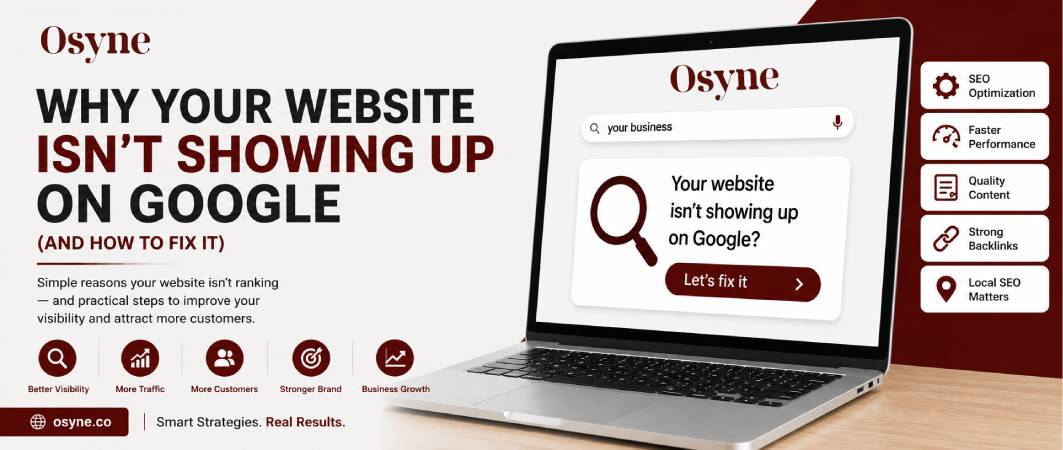
Have you ever searched for your business on Google only to discover that your website is nowhere to be found? It can be frustrating, especially after investing time and money into building a professional website.
The good news is that this is a common challenge, particularly for new or recently redesigned websites. If your website isn’t showing up on Google, it doesn’t necessarily mean something is broken. More often than not, it means there are a few important SEO fundamentals that need attention.
In this guide, we’ll explain the most common reasons your website isn’t appearing in Google search results and, more importantly, what you can do to improve your visibility.
1. Your Website Hasn’t Been Indexed Yet
Before Google can display your website in search results, it first needs to discover and index your pages.
Indexing is the process where Google crawls your website and stores information about it in its search database. If your website is brand new or you’ve recently launched a redesign, Google may simply not have indexed it yet.
How to fix it
Submit your XML sitemap through Google Search Console.
Request indexing for important pages.
Ensure your website isn’t blocking search engines through your robots.txt file or noindex tags.
A quick way to check if your website is indexed is to search:
site:yourdomain.com
If no pages appear, your website likely hasn’t been indexed yet.
2. You’re Targeting the Wrong Keywords
Many businesses unknowingly optimise their websites around phrases they use internally instead of the words potential customers actually search for.
For example, a company may describe its service as “digital transformation solutions,” while customers are searching for “website design in Kenya” or “SEO services near me.“
If your content doesn’t match what people are searching for, Google has little reason to rank your pages.
How to fix it
Research keywords before creating content.
Include your target keywords naturally in:
Page titles
Headings
URLs
Meta descriptions
Body content
Image alt text
Remember, good SEO starts with understanding your audience’s search intent.
3. Your Website Has Weak On-Page SEO
Search engines rely on many on-page elements to understand what each page is about.
Missing or poorly optimised SEO elements can significantly reduce your chances of ranking.
Common issues include:
Missing page titles
Duplicate meta descriptions
Missing H1 headings
Poor heading structure
Missing image alt text
Weak internal linking
Thin content
Even the best-looking website can struggle if these basics are missing.
How to fix it
Audit every important page on your website and make sure each one has:
A unique SEO title
A compelling meta description
One clear H1 heading
Well-structured H2 and H3 headings
Optimised images
Internal links to related pages
Small improvements across your website can make a significant difference over time.
4. Your Website Is Too Slow
Website speed matters more than ever.
Visitors expect websites to load within a few seconds. If your website is slow, people often leave before viewing your content. Google considers this when ranking websites because it wants to provide users with the best possible experience.
How to fix it
Improve loading speed by:
Compressing images
Removing unnecessary plugins
Using quality web hosting
Enabling caching
Optimising CSS and JavaScript files
A faster website improves both user experience and SEO performance.
5. Your Website Isn’t Mobile-Friendly
More than half of all internet traffic comes from mobile devices.
Google now uses mobile-first indexing, meaning it primarily evaluates the mobile version of your website when determining rankings.
If visitors struggle to use your website on a smartphone, your rankings may suffer.
How to fix it
Ensure your website:
Adapts to different screen sizes
Has readable text without zooming
Features easy-to-click buttons
Loads quickly on mobile networks
Offers a smooth browsing experience
A responsive website benefits both users and search engines.
6. You’re Not Publishing Fresh Content
Google prefers websites that continue to provide valuable, up-to-date information.
If your website hasn’t been updated for months, search engines may view it as less relevant than competitors who regularly publish useful content.
One of the easiest ways to keep your website active is by maintaining a business blog.
How to fix it
Publish helpful content consistently.
Topics could include:
Frequently asked customer questions
Industry trends
How-to guides
Case studies
Business tips
Fresh content gives Google more opportunities to discover your website and rank it for additional keywords.
7. Your Website Has Few or No Backlinks
Backlinks are links from other websites pointing to yours.
Google views quality backlinks as signals of trust and authority. Websites with strong backlink profiles generally perform better in search results.
Without backlinks, it can be difficult to compete for competitive keywords.
How to fix it
Build backlinks by:
Publishing valuable content people want to share
Writing guest articles
Listing your business in reputable directories
Partnering with industry organisations
Sharing original research or resources
Focus on earning links naturally rather than buying them.
8. You Haven’t Optimised for Local SEO
If your customers are primarily in Kenya, local SEO is essential.
When someone searches for services near them, Google prioritises businesses with complete local information.
How to fix it
Make sure you:
Optimise your Google Business Profile
Use location-specific keywords naturally
Display accurate contact information
Collect customer reviews
Keep your business details consistent across online platforms
Local SEO helps your business appear in both Google Search and Google Maps.
How Osyne Helps Businesses Improve Their Google Visibility
Getting found on Google isn’t about shortcuts or overnight success. It requires a consistent strategy built on strong technical foundations, valuable content and ongoing optimisation.
At Osyne, we help businesses improve their online visibility through:
Every recommendation we make is designed to help your website attract the right audience and generate measurable business growth.
If your website isn’t showing up on Google, don’t assume it will never rank.
Most visibility problems can be fixed by improving your SEO foundation, creating valuable content and remaining consistent over time.
Google rewards websites that provide useful information and a great user experience. By investing in the right strategy today, you’ll give your business a much stronger chance of being found by the people already searching for the products and services you offer.
If you’re unsure where your website stands, start with an SEO audit. Identifying and fixing the issues early can make a significant difference to your long-term online visibility.