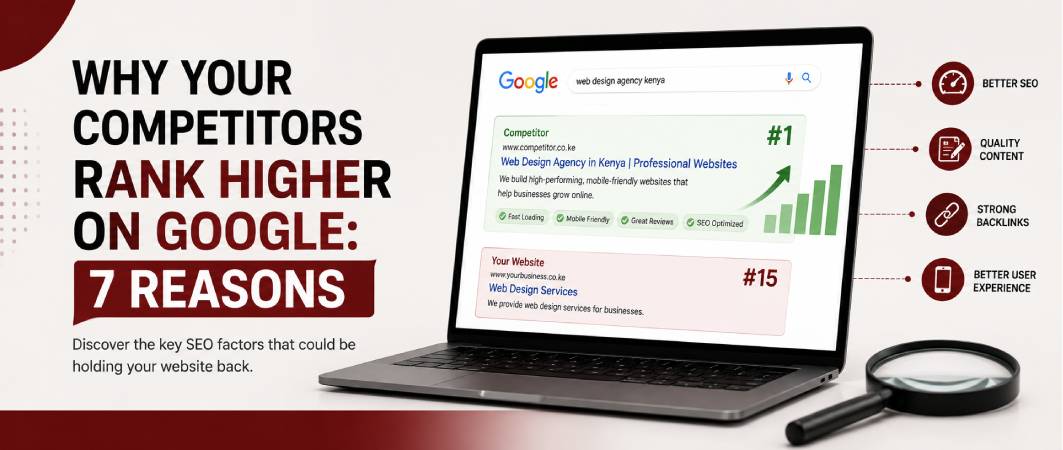
You search Google for a service your business offers, but your competitors appear on the first page while your website is nowhere to be found.
It’s frustrating, especially when you know your business can compete with them.
But ranking higher on Google isn’t simply about having a better product or being in business longer. Search engines consider hundreds of signals when deciding which websites deserve to appear at the top of search results.
If your competitors consistently outrank you, there is probably a reason.
Here are seven common reasons why.
1. Their Website Is Better Optimised for Search
Having a website isn’t enough to rank well on Google.
Your website needs to make it easy for search engines to understand:
- What your business does
- Which services you provide
- Where you operate
- Which searches your pages should appear for
- Which pages are most important
Your competitors may have better-optimised page titles, headings, URLs, content and internal links.
For example, a page simply titled “Services” gives Google very little context.
A page titled “Professional Website Design in Kenya“ provides much stronger information about what the page is about and who it serves.
Good SEO starts with making your website clear to both users and search engines.
2. They Have Better Content
Google wants to provide useful answers to people searching online.
If your competitor consistently publishes detailed, helpful content around the questions their customers are asking, they create more opportunities to appear in search results.
This could include:
- Blog articles
- Service pages
- Guides
- FAQs
- Case studies
- Location-specific content
For example, a business offering accounting services could create content around questions such as:
“How much does an accountant cost in Kenya?”
“How to file taxes for a small business in Kenya”
“Do small businesses need an accountant?”
Each useful piece of content creates another opportunity to attract potential customers through Google.
3. Their Website Has More Authority
Google doesn’t evaluate every website in isolation.
It also considers signals that indicate whether a website is trustworthy and authoritative.
One important factor is backlinks – links from other websites pointing to yours.
If reputable websites mention and link to your business, those links can help strengthen your website’s authority.
Your competitors may therefore have an advantage because they have earned links from:
- Industry websites
- Business directories
- News publications
- Partner organisations
- Local business websites
- Relevant blogs
This doesn’t mean you should chase hundreds of low-quality backlinks.
A smaller number of relevant, trustworthy links can be far more valuable than a large collection of poor-quality ones.
4. Their Website Provides a Better User Experience
SEO isn’t only about keywords.
Google wants to send users to websites that provide a good experience.
If your website is:
- Slow
- Difficult to navigate
- Not mobile-friendly
- Cluttered
- Difficult to read
- Full of broken links
you may struggle to compete with websites that provide a smoother experience.
Think about your own behaviour.
If you click a Google result and the website takes several seconds to load or is difficult to use on your phone, you’re probably going to leave.
Your potential customers behave the same way.
A fast, mobile-friendly and easy-to-navigate website gives both users and search engines a better experience.
5. They’re Targeting the Right Keywords
You may be trying to rank for keywords that are either too broad or too competitive.
For example, ranking for:
could be extremely difficult.
But targeting a more specific search such as:
“Digital marketing agency Kenya“
or a service-specific phrase may give your business a more realistic opportunity to compete.
Good keyword research helps identify:
- What your customers are actually searching for
- How competitive those searches are
- What search intent sits behind them
- Which keywords your business has a realistic chance of ranking for
The goal isn’t to rank for every possible keyword.
It’s to rank for the right keywords.
6. Your Competitors Are More Consistent
SEO isn’t a one-time task.
Your competitor may have spent months or years improving their website, publishing content, earning backlinks and updating their pages.
Meanwhile, you may have optimised your website once and left it untouched.
That creates a significant difference over time.
Successful SEO requires ongoing work.
This could involve:
- Publishing useful content
- Updating existing pages
- Improving technical SEO
- Monitoring keyword rankings
- Building relevant backlinks
- Improving underperforming pages
- Analysing search data
Small improvements made consistently can create significant results over time.
7. Their Local SEO Is Stronger
If you operate a local business, your Google visibility isn’t determined by your website alone.
Your Google Business Profile can play an important role in helping customers discover your business through local searches.
Your competitors may have:
- A fully completed Google Business Profile
- More genuine customer reviews
- Accurate business information
- Regular updates
- Relevant business categories
- Strong local citations
For searches with local intent, these factors can make a major difference.
For example, someone searching:
is likely looking for a business they can actually contact.
Having a strong local presence can therefore put your business in front of customers at exactly the right moment.
So, Why Are Your Competitors Ranking Higher?
It may not be because they’re doing one thing dramatically better than you.
Often, the difference comes from several small advantages working together.
They may have:
Better content + stronger SEO + better website performance + more authority + stronger local visibility.
Over time, those advantages compound.
The good news is that your competitors’ current rankings don’t mean you can’t catch up.
You need to understand where the gaps are and build a strategy around fixing them.
How to Find Out What’s Holding Your Website Back
Before changing everything on your website, start with an SEO audit.
Look at:
- Your current Google rankings
- Target keywords
- Website speed
- Mobile experience
- Technical SEO
- Page titles and descriptions
- Content quality
- Internal links
- Backlinks
- Google Business Profile
- Competitor performance
This gives you a clear picture of where your biggest opportunities are.
Instead of guessing what Google wants, you can build your SEO strategy around actual data.
Ready to Outrank Your Competitors?
Ranking higher on Google takes time, strategy and consistent optimisation.
At Osyne, we help businesses improve their search visibility through SEO strategy, technical optimisation, content and websites built with search performance in mind.
If your competitors are getting the clicks and enquiries you want, it’s time to find out why.
Get in touch with Osyne and let’s build an SEO strategy designed to help your business compete.